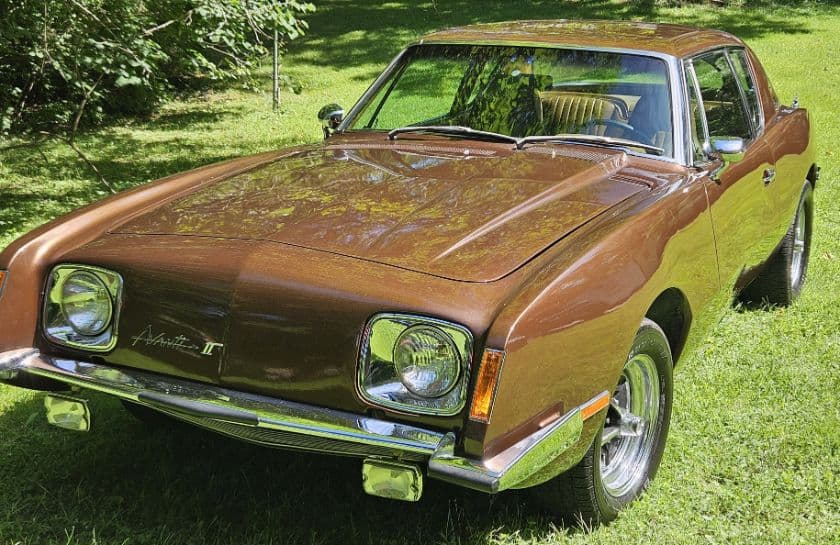
Studebaker Avanti
Raymond Loewy's farewell — the most advanced American car of 1963 and a bonafide record-setter.
The Avanti was Raymond Loewy's final major American automotive commission, designed in 40 days at a rented home in Palm Springs. Despite being rushed to market, it became one of the most advanced American cars of the era — fiberglass body, disc brakes standard, supercharged option producing 289+ hp, and a 0–60 time under 7 seconds. Andy Granatelli drove modified Avantis to 29 speed records at Bonneville in 1962.
History
Studebaker president Sherwood Egbert commissioned Loewy to design a new halo car that could reverse the brand's fortunes. The result was unlike any American car — a fastback with no external door handles, a roll bar integrated into the roof, disc brakes on all four wheels as standard equipment, and an aerodynamic nose with no traditional grille opening. The R2 supercharged version produced 289 hp from 289 cubic inches.
Despite critical acclaim, production issues and Studebaker's imminent financial collapse limited the Avanti to 4,647 units over two model years. After Studebaker closed its South Bend factory in December 1963, two dealers purchased the tooling and continued production as 'Avanti II' through 1991. The original Studebaker-built cars are the collector pieces; the R3 supercharged racing version is the most valuable.
Notable Versions
R2 Supercharged
Paxton supercharger, 289 hp — 1 hp per cubic inch, a racing benchmark. The street Avanti to have.
R3 (1963)
Race-only supercharged variant, 335 hp. Approximately 9 built. Bonneville record setter.
Avanti II (1965–1991)
Dealer-continued production after Studebaker's closure. Not the original, but valuable as continuation vehicles.
What to Look for When Buying
Key inspection points from experienced collectors.
Fiberglass body requires different inspection technique
Unlike steel, fiberglass doesn't rust — but it does crack, delaminate, and suffer stress fractures. Inspect in good light for repairs and cracks.
Studebaker vs Avanti II is critical to value
Studebaker-built cars (1963–64 VINs) are worth considerably more than Avanti II continuation cars. Verify the VIN prefix.
R-designation supercharger authenticity
The R2 and R3 supercharger installations are valuable and verifiable. The Studebaker Drivers Club registry is the authority.
Quick Specs
- Engine options
- R1: 289 V8, 240 hp; R2: 289 supercharged, 289 hp; R3: 289 supercharged race, 335 hp
- Body
- Fiberglass — unique for an American car in 1963
- Brakes
- Four-wheel disc standard — a first for an American production car
- Production
- 4,647 Studebaker-built (1963–64)
Market Price Guide
Approximate USA asking prices
Ready to find one?
Browse current Studebaker Avanti listings from trusted dealers.
View All Listings →Shop Parts
Find Studebaker Avanti parts on eBay
Shop on eBay →We may earn a referral fee if you make a purchase through this link, at no additional cost to you. Learn more
Studebaker Avanti For Sale
3 listings currently available