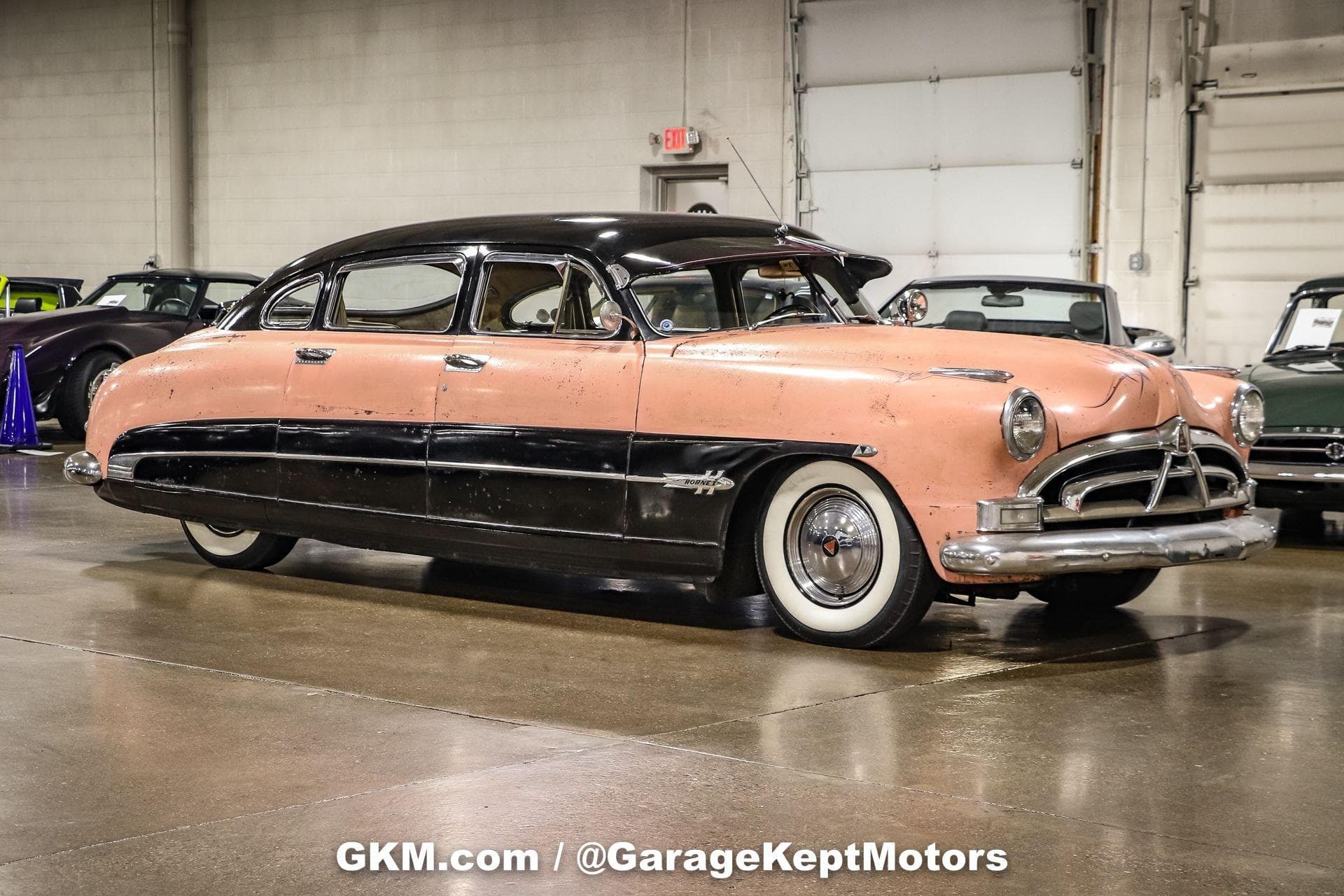
Hudson Hornet
The low-slung "step-down" sedan that dominated early NASCAR racing and inspired Pixar's Doc Hudson.
Built on Hudson's innovative "step-down" unibody chassis — where passengers sat within the frame rails rather than on top of them — the Hornet combined an exceptionally low center of gravity with a powerful, torquey inline-six to become one of the most dominant cars in early NASCAR history. Its racing success, achieved against V8-powered rivals from bigger manufacturers, remains one of the great underdog stories in American motorsport.
History
The step-down unibody design, introduced across Hudson's lineup in 1948, put the floor pan below the frame rails rather than above them — a genuinely novel approach that gave the whole range, and the Hornet in particular, superior handling and stability for the era.
Fitted with a 308-cubic-inch inline-six making up to 145 hp with the optional "Twin H-Power" dual-carburetor setup, the Hornet punched well above its displacement and out-handled larger V8 rivals thanks to its low, stable chassis.
Under legendary driver Marshall Teague and factory-backed "Fabulous Hudson Hornet" racing efforts, the car won the majority of NASCAR Grand National races in 1952 and 1953 — a dominant run against Oldsmobile, Chrysler, and other V8-powered competitors that cemented the Hornet's reputation.
Notable Versions
Twin H-Power
Dual-carburetor factory option raising output to 145 hp — the performance specification most associated with the racing Hornets.
"Fabulous Hudson Hornet" Racing Cars
Factory-backed NASCAR competitors driven by Marshall Teague and others, dominant through 1952–53.
Hollywood Hardtop
Pillarless hardtop coupe body style, offering a sportier profile than the standard sedan.
What to Look for When Buying
Key inspection points from experienced collectors.
Step-down unibody rust is a serious structural concern
Unlike body-on-frame cars of the era, rust in a step-down Hudson's unibody directly affects structural integrity — a thorough inspection is essential.
Verify Twin H-Power originality
The dual-carb setup is central to the Hornet's performance reputation and value — confirm it's genuine rather than a later addition.
Parts availability is limited compared to bigger-brand cars of the era
Hudson's relatively low production and 1954 merger into AMC make trim and mechanical parts harder to source than for a contemporary Ford or Chevrolet.
Inspect the flathead six for oil leaks and cooling issues
A generally robust engine, but deferred maintenance shows up as leaks and overheating — verify service history.
Be skeptical of unsubstantiated racing-history claims
Given the Hornet's NASCAR fame, verify any claimed competition history against real documentation rather than a seller's story alone.
Quick Specs
- Engine
- 308 cu in flathead I6
- Horsepower
- 145 hp (Twin H-Power)
- Wheelbase
- 124 in
- Weight
- approx. 3,500 lbs
- Transmission
- 3-speed manual (overdrive optional); Hydra-Matic automatic optional
- 0–60
- approx. 12–13 seconds
Market Price Guide
Approximate USA asking prices
Shop Parts
Find Hudson Hornet parts on eBay
Shop on eBay →We may earn a referral fee if you make a purchase through this link, at no additional cost to you. Learn more
Hudson Hornet For Sale
1 listing currently available